ACTIVITIES
AND HISTORY OF THE VAL MASINO
TERRITORY
The
Valley and its boundaries
The mountains form the boundaries of the Val Masino, which is
narrow southwards but enlarges and branches off eastwards and
north-easterly in the Sasso Visolo and Preda Rossa Valleys and
in the Val di Mello, westwards and northwards in the Bagni and
Porcellizzo Valleys. The Valchiavenna is just beyond the ridge
Mount Spluga - Cima Barbacane, and the Valmalenco can be reached
by getting over the Corni Bruciati (Maroon horns) – Mount
Disgrazia and Mount Sissone. To the north the national boundaries
of the Rhaetian Alps (from Badile to peak Bondasca) divide the
Val Masino and Italy from the Val Bregaglia – Switzerland.
It originated from the Quaternary glaciation, which disclosed
the Alps and the beautiful granite valleys surrounding them.
Luxuriant
vegetation
The vegetation is typical of the Rhaetian side of the Alps with
thick undergrowth, mainly chestnuts and beeches. The moist area
of the Bagni Valley has allowed both the beech and the white fir
to thrive. The red fir, which predominates at middle altitude,
gives way to alpine pastures at high altitude. The highest valleys
are subject to great changes in temperature. Due to this phenomenon,
thickets of rhododendrons grow and grassland extends as far as
the stony ground of the snowfields at high altitude. The highest
point in the valley is Mount Disgrazia (3678m.)
Some
geology
Geologically the Valley is divided into two areas: the one to
the west is made of diorite and of ghiandone, a variety of granite,
whereas the one to the east is made of serpentine. This serpentine
is not green like the one you find in the neighbouring Valmalenco,
but it is covered with a reddish patina due to weathering, which
gave rise to the Corni Bruciati.
Among
high peaks and snowfields
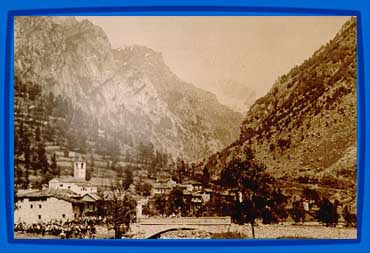
From San Martino you can see the Valley in its entirety, its green
pastures, its alpine amphitheatres and its granite summits, which
marked the history of modern mountaineering. Behind the village
of San Martino, towards the east there is there is the beautiful
and level Val di Mello, towards the north you can reach the Bagni
Valley, where the Merdarola, Ligoncio and Porcellizzo Valleys
join.
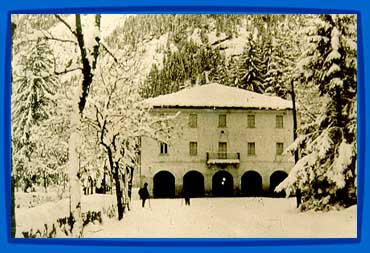
The carriage road continues towards the Bagni (Baths) bending
at first among woods of firs and larches, then among woods of
beeches. Next to the road you can see some granite quarries. Now
we have reached the Bagni. Here the carriage road ends but just
past the bridge there is the road leading to the thermal spring
which has been famous since the 16th century. The paths leading
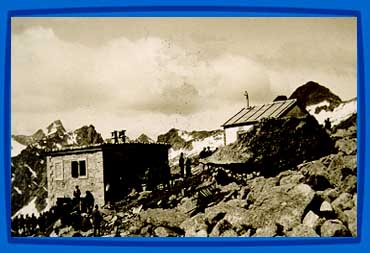
to the refuges Omio (2108m.) and Gianetti (2534m.) branch off
here, as well as the Sentiero Roma (Rome path), the “high
way” of the Val Masino.
TOURISM
It
is what is nowadays called sectoral tourism: thermal, naturalistic,
cultural, artistic, gastronomic, linked to skiing, mountaineering
and to the typical food and artisan productions. Tourism has been
present in Valtellina for many centuries.
“In una valle chiamata la valle del Masxeno contigua agli
alpi di Bregaglia è uno bagno assay caldo proximo a Morbegno
e dodexe miglia, verso il quale si potria cavalcare assay comodamente”
letter written by the podestà (the ancient mayor) of Morbegno
in 1492 in order to induce the Duke of Milan to go to the Baths
of Masino. In the past, tourists used to belong to the elite and
they contributed to the spread of the bucolic and agricultural
image of the Valtellina of the time. In Val Masino modern tourism
started with the coming of mountaineering and after the conquest
of some peaks in the valley by the English. Today, the lower Valtellina
is not a destination for the masses, it is a limited phenomenon.
Its peculiarities make it an unique environment which can fulfil
various desires and expectations, among which the main are: every
kind of mountaineering, alpine skiing, natural and artistic tourism,
mountain biking, food and wine. Every visit is an unique discovery
rich in fascinations and it turns into an everlasting memory.